Working capital is one of the most powerful levers for performance – yet many improvement-efforts stall or fail to stick. The reason is rarely bad intent or lack of data. More often, it’s something harder to see: supply chain bias.
Supply chain bias arises when functions optimize for their own goals – sales padding forecasts, procurement chasing unit cost savings, operations hoarding stock – without considering the wider system. Each choice may feel rational, but together they create excess buffers, distort signals, and lock in more operating working capital than the business truly needs.
This article explores how supply chain bias creeps into day-to-day decisions, how to distinguish bias from genuine supply chain constraints, and what companies can do to break free. By tackling bias head-on, organizations can release trapped cash, improve agility, and align finance, operations, and supply chain around one common Setpoint for success.
The Operating Working Capital Setpoint - Table of Contents
Want to download this article for free?
Create a free account on My Academy Hub to download the article The Hidden Enemy of Working Capital: How Supply Chain Bias Drains Cash and Agility today.
Supply chain bias is the hidden barrier that makes working capital improvements stall or reverse, even when every function is acting rationally.
It arises from local optimization: functions chasing their own KPIs, outdated assumptions, or misaligned incentives that ignore system-wide outcomes.
Bias is not the same as constraint. Constraints set the baseline OWC you must carry; bias inflates the rest. Confusing the two locks in inefficiency.
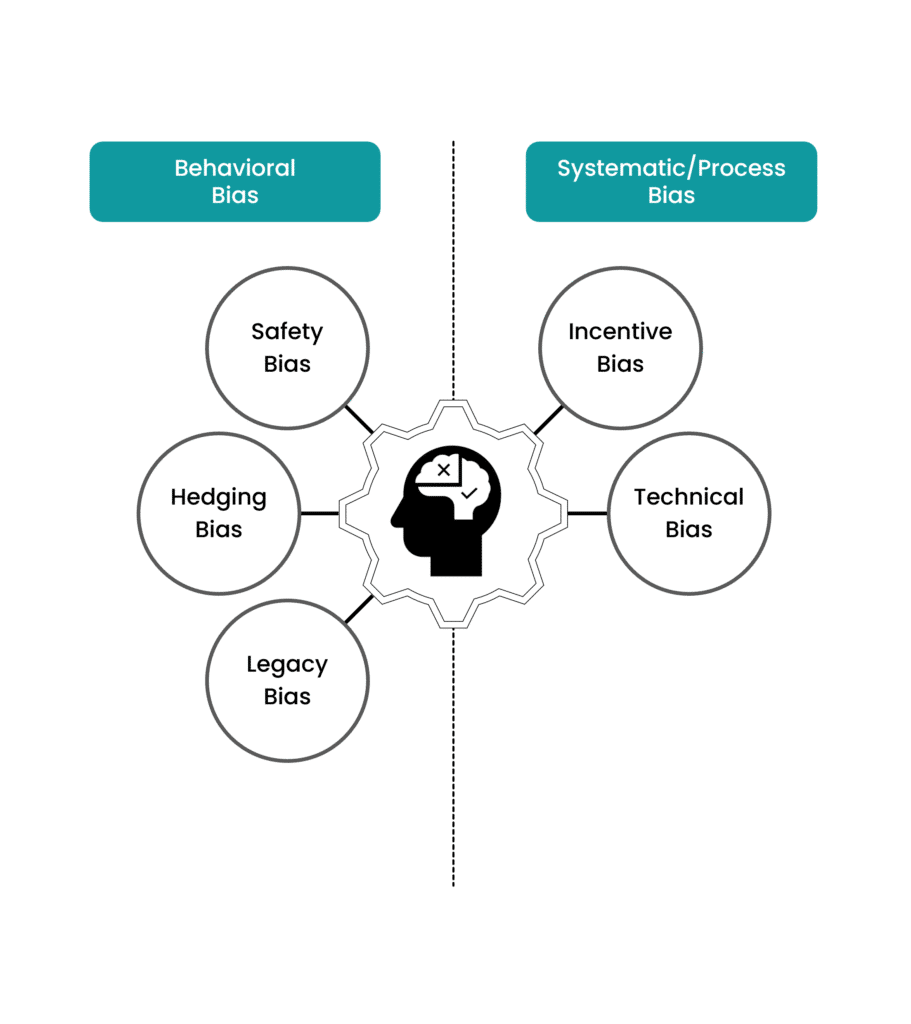
Biases fall into two categories:
Behavioral: habits, risk aversion, or legacy thinking.
Systemic: structural issues in processes, KPIs, or tools.
Five common biases – safety, hedging, legacy, incentive, and technical – quietly trap cash, reduce agility, and erode trust.
Breaking through requires discipline and alignment:
Define your OWC Setpoint, using benchmarks to set a shared reference.
Fix causes, not symptoms, so buffers don’t return.
Align incentives and KPIs across functions to stop local wins from becoming system losses.
Strengthen S&OP as the engine for cross-functional coordination.
Take incremental steps – biases accumulated over years and must be unwound over time.
Above all, treat OWC as a shared operational responsibility, not just a finance metric. This shift unlocks lasting improvements in liquidity, service, profitability, and resilience.
Why Operating Working Capital Improvements So Often Stall
Operating working capital (OWC) is one of the most direct levers for financial performance:
Free up cash, and you improve liquidity.
Streamline flows, and you gain agility.
Improve efficiency and effectiveness, and you boost profitability.
In theory, improvement should be straightforward. In practice, however, many programs deliver short-term gains only to stall-or even reverse-over time.
The reason is not a lack of effort or bad intentions. It lies in the natural fault lines across the supply chain:
Finance pushes for liquidity.
Operations push for stability.
Sales push for growth.
Procurement pushes for savings.
Each function is acting rationally, pursuing metrics that make sense within its own domain. But when those actions are taken in isolation, they don’t add up to system-wide improvement. Instead, they add up to:
Friction between functions, suppliers, and customers
Missed opportunities to optimize end-to-end performance
This paradox – where every function appears to be “winning,” yet the business as a whole is losing – is the hallmark of Supply Chain Bias.
It’s the hidden force that locks in higher working capital than necessary, undermines improvement, and leaves companies wondering why progress never seems to stick.
Supply chain bias is the tendency for functions to optimize their own goals – sales chasing revenue, procurement chasing unit cost savings, operations chasing stability – without considering the broader system impact.
These decisions often make perfect sense locally, but collectively they trap cash, slow down flows, and undermine profitability.
The antidote is alignment around a company’s true Operating Working Capital (OWC) Setpoint – the optimal balance of healthy inventory, receivables and payables needed to support operations and strategy. Without this reference point, teams fall back on informal “safety nets” that feel protective but ultimately hold the business back:
Extra stock “just in case”
Inflated forecasts to secure resources
Front-loaded purchases to avoid shortages
Overextended supplier terms to hit cash targets
While these tactics may relieve immediate pain, they create longer-term harm:
Masking root causes, fostering complacency instead of improvement
Distorting flows of goods, cash, and information across the supply chain
Locking in excess working capital, reducing liquidity and flexibility
Think of it like packing extra supplies into a hiking backpack “just in case.” Each item feels protective, but the load makes you slower, less flexible, and more exhausted. Supply chain bias works the same way: buffers feel safe, but they weigh the organization down.
In the language of the Theory of Constraints, supply chain bias is a classic case of local optimization: improving one node at the expense of the whole network. The outcome is predictable – apparent wins at the function level, but systemic underperformance for the business as a whole.
Supply Chain Bias vs. Constraint: A Critical Distinction
Not all working capital needs are the result of bias. Some are inherent conditions and constraints built into the supply chain-lead times, production cycles, or customer payment practices. These realities set the baseline OWC requirement that every business must carry to function.
Bias, by contrast, is optional. It reflects subjective perceptions, risk aversion, or localized fixes layered on top of real constraints. Left unchecked, bias solidifies into habit – “the way we do things here” – and obscures the company’s true Setpoint.
The danger is subtle but serious: when bias is mistaken for constraint, leaders accept inflated working capital levels as inevitable. Cash gets trapped, agility erodes, and opportunities for improvement are lost.
The Japanese Sea Analogy
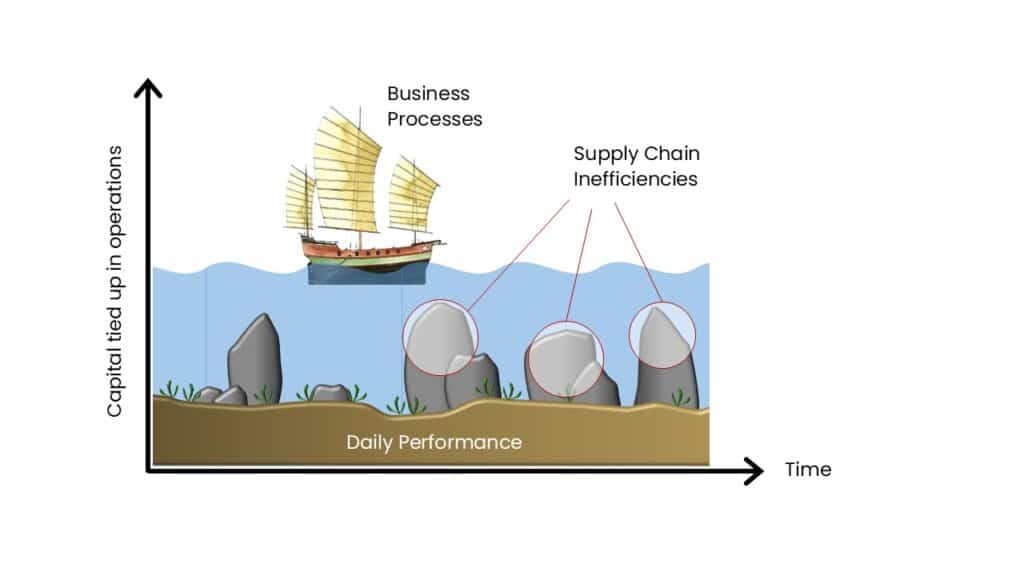
A useful way to picture this distinction comes from Lean philosophy – the classic “Japanese Sea” analogy:
The boat represents business operations
The sea level represents working capital
The rocks beneath represent inefficiencies
When the water level is high enough, the rocks stay hidden – but they haven’t gone away. Many companies try to free up cash by draining the sea (reducing operating working capital) without first addressing the rocks (inefficiencies).
The result is predictable: the boat runs aground, service levels suffer, and the business quickly raises the water back up – often higher than before.
The real lesson? Constraints define the minimum; bias inflates the rest. True progress requires both identifying your Setpoint and methodically removing the rocks. Only then can the water be lowered safely, unlocking sustainable improvements in working capital, efficiency, and resilience.
Two Forms of Supply Chain Bias
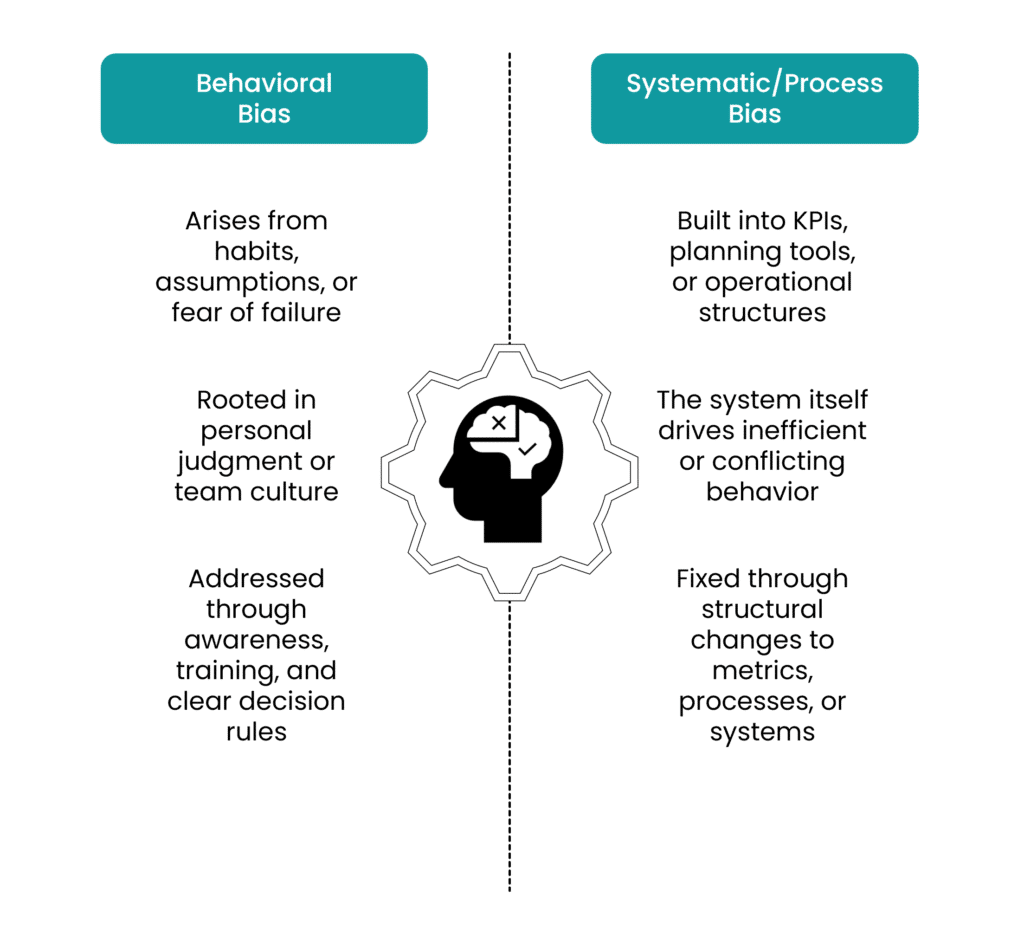
Not all biases are created equal. They tend to cluster in two categories – each requiring a different approach to fix.
1. Behavioral Supply Chain Bias
These arise from human habits, assumptions, and cultural norms. They are often informal responses to risk or past experience:
Risk aversion: “We had a stockout once – never again.”
Inflated forecasts: padding demand numbers to protect quotas.
Legacy rules: clinging to “tribal knowledge” long after conditions have changed.
Behavioural biases feel natural because they are rooted in judgment and memory. But they quietly accumulate, creating buffers that trap cash.
The remedy lies in awareness and discipline: training teams, challenging assumptions with data, and setting clear decision-making guidelines.
2. Systemic Supply Chain Bias
Systemic biases are different. They are hardwired into the way the business is run-baked into tools, KPIs, or planning structures:
KPIs that reward bulk buying, even if it inflates inventory.
Forecasting systems that rely on outdated assumptions.
Planning logics that shift uncertainty downstream instead of resolving it.
Because these biases are structural, no amount of retraining will fix them.
The solution is redesign: aligning incentives across functions, updating planning logic, and ensuring data reflects reality.
Why the Distinction Matters
Treating a systemic bias like a behavioural one – or vice versa – wastes effort and stalls progress. A planner trained to forecast more accurately will still distort demand if the KPI rewards over-forecasting.
Conversely, a new planning system won’t eliminate ingrained habits of over-ordering unless people are coached to trust it.
By recognizing whether a bias is behavioural or systemic, leaders can target the right corrective action-retraining individuals, redefining standards, or rethinking the very systems and incentives that shape decisions.
This is what transforms bias from an invisible drain on working capital into a visible opportunity for sustainable improvement.
Five Common Supply Chain Bias in Action
Supply chain bias doesn’t live in theory – it shows up in everyday decisions.
Here are five recurring patterns that quietly inflate working capital and erode performance:
1. Safety Bias – Hiding risk behind extra stock
This occurs when teams add inventory buffers instead of addressing root causes.
Example: A warehouse manager increases safety stock to cover for late deliveries.
Impact: The symptom is masked, but the supplier reliability issue remains unresolved. Working capital rises while improvement stalls.
2. Hedging Bias – Inflating demand to protect targets
This happens when teams exaggerate forecasts to safeguard resources or quotas.
Example: Sales reps overstate demand to secure product availability.
Impact: Demand signals are distorted, production gets overloaded, and imbalances appear – leading to excess stock in some products and shortages in others.
3. Legacy Bias – Letting the past dictate the present
Old experiences or unwritten rules become the default, even when circumstances have changed.
Example: “Last time we cut stock, we had a disaster.”
Impact: Yesterday’s buffers become today’s waste, keeping cash locked up unnecessarily.
4. Incentive Bias – Misaligned metrics driving the wrong behaviors
When KPIs reward local success at the expense of the whole system, bias takes root.
Example: A buyer focuses on unit cost savings by ordering in bulk.
Impact: The KPI looks good, but the business suffers from excess inventory, reduced cash, and weaker agility.
5. Technical Bias – Trusting models more than reality
This arises when systems and parameters are not updated to reflect actual conditions.
Example: A planning system uses outdated lead times.
Impact: The plan looks precise on paper, but execution falters. Buffers grow to compensate for the gap between assumption and reality.
The Bigger Picture
These five biases are not the result of “bad actors.” They emerge from misaligned goals, incentives, and mental models that make local decisions seem rational. Left unchecked, they:
Trap cash in unnecessary buffers
Reduce organizational agility
Erode trust between functions and partners
Recognizing these patterns is the first step. Challenging them – and redesigning the conditions that sustain them – is what turns operating working capital from a chronic drag into a strategic advantage.
The Budget Process: A Hidden Source of Supply Chain Bias
While supply chain bias often shows up in day-to-day decisions – forecasting, inventory, purchasing – its roots frequently lie higher up in the organization: in the budgeting process.
We’ve seen this across industries: many companies struggle with operational inefficiencies and conflicting targets that originate indirectly, or even directly, from how budgets are set. The problem isn’t budgeting itself, but the way it is often performed.
When trust is missing, the process becomes a cycle of gaming and second-guessing:
Boards or CEOs distrust bottom-up proposals, assuming they are understated, and impose arbitrary top-down increases.
Sales and operations managers, anticipating this, understate their estimates as a protective measure.
The result? A self-fulfilling prophecy: budgets that lack ownership, misaligned targets, and a breeding ground for bias.
This mistrust-driven budgeting dynamic often leads to:
Unrealistic sales targets that inflate forecasts, drive excess inventory, or push unprofitable sales.
Arbitrary cost-cutting that leaves the organization stretched too thin.
Misaligned incentives between sales and operations, each protecting its own agenda.
In short, a dysfunctional budget process creates the very conditions – safety, hedging, and incentive biases – that inflate working capital and undermine agility.
A Better Way Forward
An alternative is to design the budget as a trust-based, bottom-up process, where:
Each function provides an unbiased view of potential, grounded in real constraints and opportunities (the company’s Setpoint).
Structural levers and investment needs are made explicit, not hidden.
The CEO plays a pivotal role by aligning targets, supporting the team in looking beyond immediate constraints, and managing board expectations.
When budgeting is built on trust, alignment, and realism, it stops being a source of bias and becomes a catalyst for sustainable performance.
Breaking Through Supply Chain Bias
Eliminating supply chain bias is not about adding new rules or generating more reports. It’s about reshaping how the business thinks and acts – shifting from local optimization to system – wide alignment. That requires both a mindset shift and cross-functional collaboration.
Here’s how to start:
1. Define your Setpoint
Establish the optimal levels of receivables, inventory, and payables for your business model, service goals, and risk tolerance.
Why it matters: Without a clear Setpoint, every function creates its own version of “safe,” leading to inflated buffers. Use internal data and external benchmarks to calibrate what “good” looks like.
2. Fix causes, not symptoms
Don’t just strip away buffers. First, understand why they were added – forecast errors, unreliable suppliers, poor visibility, or misaligned KPIs.
Why it matters: Removing a buffer without solving its root cause only guarantees it will come back, often larger than before.
3. Align incentives and KPIs
Move beyond siloed metrics. Procurement, sales, operations, and finance must share accountability for cash, cost, and service.
Why it matters: What gets measured gets done. Misaligned KPIs perpetuate bias; aligned KPIs dismantle it.
4. Strengthen S&OP as a coordination engine
Sales & Operations Planning (S&OP) should be more than a meeting – it should be the forum where trade-offs are surfaced, assumptions are tested, and biases are challenged.
Why it matters: A mature S&OP process forces the organization to make end-to-end decisions, not just local fixes.
5. Take incremental steps
Supply chain biases build up over years, often decades. Breaking them is not a one-off project but a continuous journey.
Why it matters: Small, systematic improvements build trust and prove the value of change – making larger shifts possible.
The Leadership Imperative
Supply chain bias cannot be eliminated by one function alone. It takes leadership commitment to set the reference point, align incentives, and foster collaboration.
The payoff is substantial: not only freed-up cash, but also improved agility, stronger trust, and a supply chain that performs as a system -not just a collection of parts.
Conclusion
Operating working capital is too important to be left to chance – or to the biases of individual functions. While finance may see it as a metric of liquidity, its roots lie deep in how the supply chain is planned, measured, and managed day to day.
The truth is simple but often overlooked: bias is optional, constraint is not. Every company will always carry some level of working capital because of its industry, operating model, and customer requirements. But much of what sits on balance sheets today is not necessity – its bias disguised as safety, efficiency, or best practice.
The companies that win are those that make bias visible, challenge it openly, and align the organization around its true Setpoint. That requires leadership courage, functional collaboration, and the discipline to fix causes instead of covering symptoms.
The payoff is not just freed-up cash. It is a supply chain that is leaner, more agile, more trusted, and ultimately more profitable. Breaking supply chain bias is not only a financial imperative – it is a strategic one.
Frequently Asked Questions
Q1. What is supply chain bias?
Supply chain bias is the tendency for functions or individuals to optimize for their own goals - such as sales inflating forecasts, operations hoarding stock, or procurement chasing unit cost savings - without considering the wider system. These local decisions often feel rational but collectively inflate operating working capital (OWC), trap cash, and reduce agility.
Q2. How is supply chain bias different from a supply chain constraint?
Constraints are structural realities (e.g., lead times, production cycles, or customer payment practices) that set the baseline OWC a company must carry.
Bias is optional - subjective fixes, habits, or misaligned incentives layered on top of constraints. Bias creates unnecessary buffers and makes OWC higher than it needs to be.
Q3. What are the most common forms of supply chain bias?
Five patterns appear frequently across industries:
Safety Bias – Holding excess stock to hide supplier or process issues.
Hedging Bias – Inflating forecasts to secure resources or protect targets.
Legacy Bias – Relying on outdated rules or past experiences.
Incentive Bias – KPIs that drive local wins but system losses.
Technical Bias – Planning tools and assumptions that don’t match reality.
Q4. Why do working capital improvement programs often stall?
Because functions act rationally in silos - finance wants liquidity, operations want stability, sales want growth, procurement wants savings. Each goal makes sense in isolation, but together they create excess buffers, friction, and missed opportunities. This is the hallmark of supply chain bias.
Q5. How can companies identify supply chain bias?
Look for recurring patterns of excess buffers or persistent inefficiencies that aren’t explained by real constraints. Examples include:
Forecasts that are consistently overstated.
Inventory levels that stay high despite stable demand.
KPIs that reward behaviors misaligned with cash and service goals.
Cross-functional reviews and benchmarking against a defined Setpoint can help expose where bias has crept in.
Q6. How do you break through supply chain bias?
Define your Setpoint: Establish optimal OWC levels based on your business model and benchmarks.
Fix causes, not symptoms: Understand why buffers exist before removing them.
Align incentives: Redesign KPIs to encourage system-wide performance.
Strengthen S&OP: Use integrated planning to surface trade-offs and challenge assumptions.
Take incremental steps: Biases build over years and require steady, systematic effort to unwind.
Q7. Who should own the effort to reduce supply chain bias?
No single function can fix bias on its own. Success requires:
Leadership commitment to set the Setpoint and align goals.
Finance, operations, sales, and procurement working together.
Cross-functional accountability for service, cost, and cash flow.
Ultimately, OWC should be treated as a shared operational responsibility, not just a finance metric.
Q8. What benefits can companies expect from addressing supply chain bias?
Improved liquidity through freed-up cash.
Greater agility and resilience in responding to market shifts.
Stronger trust and collaboration across functions and with suppliers.
Sustainable improvements in service, efficiency, and profitability.
Ready to take the next step?
Turn theory into practice and boost your career with accredited training. Become a Certified Working Capital Expert by enrolling in our flagship course: Managing Working Capital.
The Cash Conversion Cycle (CCC) is one of the most widely used working capital metrics - but what does it actually measure? This article explains how to calculate the cash
What is a good Cash Conversion Cycle? Most companies treat the Cash Conversion Cycle (CCC) as a race to the bottom - the shorter, the better. But in reality, a
Distorted demand signals don’t just disrupt operations - they quietly destroy working capital. Small shifts in consumer behaviour can cascade into bloated inventory, volatile capacity, and contaminated demand data across