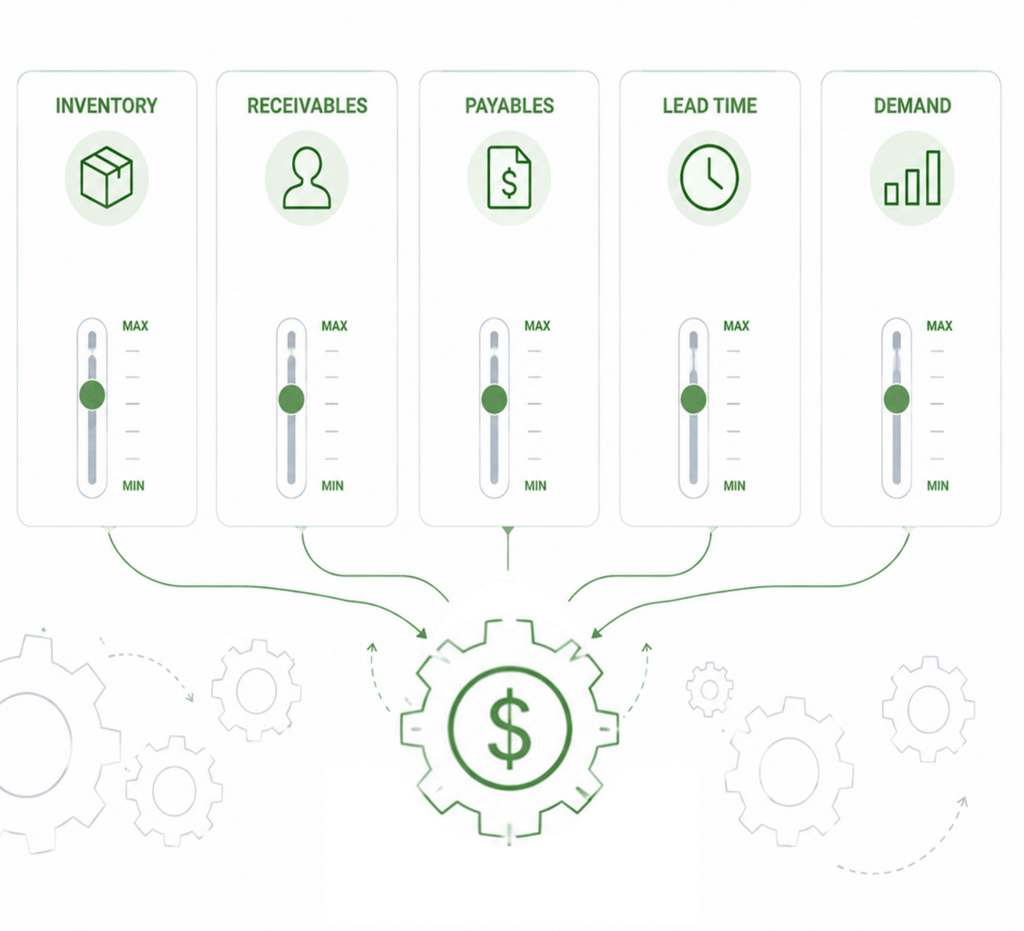
Cash is the oxygen of business. A company can report strong profits and still face financial distress if it cannot generate enough cash flow to meet its day-to-day obligations. Salaries, supplier payments, investments, debt repayments, and growth initiatives all require cash – not accounting profit.
One of the most important drivers of business liquidity is Working Capital – particularly Operating Working Capital (OWC), which reflects how much capital is tied up in day-to-day operations.
How efficiently this capital moves through the business directly influences cash flow, financial flexibility, and the company’s ability to fund operations, growth, and resilience.
This fact sheet explains the relationship between operating working capital and cash flow, explores the operational drivers that influence both, and illustrates the impact through practical examples and business applications.

Want to go beyond the basics?
Become a Certified Working Capital Expert with our CPD accredited course Managing Working Capital
Without sufficient cash flow, even profitable companies can struggle to sustain day-to-day operations, finance growth, repay debt, or withstand unexpected disruptions.
Working capital plays a critical role in determining how much cash remains available within the business. Want to explore the fundamentals of Working Capital further? Read: What is Working Capital – Definition, Formula & Business Application.
When excessive amounts of cash are tied up in receivables or inventory – or when supplier financing decreases – liquidity pressure increases and financial flexibility declines.
Consider two companies with identical sales and profitability:
| Company with inefficient OWC | Company with Efficient OWC |
|---|---|
| Excess inventory and slow collections tie up cash | Efficient collections and balanced inventory improve liquidity |
| Higher borrowing needs and funding pressure | Stronger internally generated cash flow |
| Reduced operational flexibility | Greater flexibility to invest and respond to market changes |
| Increased liquidity risk during downturns | Stronger resilience across economic cycles |
Although both companies may report similar profits, their ability to generate and retain cash can differ dramatically.
The lesson is simple: profitability does not guarantee liquidity. Operating working capital is one of the most important bridges between accounting profit and actual cash flow.

Operating Working Capital (OWC) measures how much capital is tied up in a company’s day-to-day operations.
It focuses specifically on operational current assets and liabilities such as:
A simplified Operating Working Capital formula is:
OWC = Inventory + Accounts Receivable − Accounts Payable

OWC reflects how much cash is absorbed by operational activities before customer payments are collected. Higher levels of operating working capital generally tie up more cash in operations, while lower levels reduce funding requirements and improve liquidity.
Because operating working capital directly influences cash availability, it plays a central role in determining a company’s operating cash flow, liquidity position, and financial flexibility.
Want to better understand Operating Working Capital? Read: What is Operating Working Capital? Definition, Formula and Business Application.

Cash flow represents the net movement of cash into and out of a business over a given period. Unlike accounting profit, cash flow reflects actual cash received and paid.
A company may report strong profits while still experiencing liquidity pressure if customer payments are delayed, inventory levels increase, or large investments consume cash.
Cash flow is reported in the Cash Flow Statement, which is typically divided into three main sections:
| Cash Flow Category | Description | Why It Matters |
|---|---|---|
| Cash Flow From Operating Activities | Cash generated from the company’s core day-to-day operations, including customer payments, supplier payments, wages, taxes, and changes in Operating Working Capital (OWC). | The most important measure of whether the company’s operations generate sufficient cash to sustain the business. |
| Cash Flow From Investing Activities | Cash used for or generated from investments in long-term assets such as equipment, facilities, acquisitions, or financial investments. | Often reflects how the company invests in future growth and operational capacity. |
| Cash Flow From Financing Activities | Cash flows between the company and its owners or lenders, including borrowing, debt repayments, dividends, and equity financing. | Reflects how the business finances operations, growth, and shareholder returns. |
From a working capital perspective, Operating Cash Flow is typically the most important category because it directly reflects how operational decisions influence liquidity and cash availability.

A company reports strong profitability during the quarter, but several operational changes absorb cash and reduce liquidity:
Although accounting profit remains positive, these operational changes negatively impact operating cash flow.
| Item | Impact on Cash Flow | Amount |
|---|---|---|
| Customer payments received | Cash inflow | +$500,000 |
| Increase in Accounts Receivable | Cash tied up in unpaid invoices | -$500,000 |
| Increase in Inventory | Cash tied up in stock | -$150,000 |
| Faster supplier payments | Reduced Accounts Payable funding | -$100,000 |
| Net Operating Cash Flow Impact | Cash absorbed by operations | -$250,000 |
This example illustrates how profitable growth can still create liquidity pressure when cash becomes tied up in Operating Working Capital.
Although the company reports positive profits, delayed customer payments, higher inventory levels, and reduced supplier financing absorb cash and weaken operating cash flow.
The example highlights why companies must manage not only profitability, but also how efficiently cash moves through day-to-day operations. Strong working capital management helps ensure that accounting profits are converted into usable cash that can support operations, investments, resilience, and growth.

The relationship between Operating Working Capital (OWC) and cash flow is straightforward but highly important: how a company manages receivables, inventory, and payables directly influences how much cash remains available within the business.
When operating working capital increases, more cash becomes tied up in day-to-day operations. When operating working capital decreases, cash is released back into the business and liquidity improves.
The three primary operating working capital levers influence liquidity in different ways:
| Lever | Increase in OWC | Decrease in OWC |
|---|---|---|
| Inventory | More cash becomes tied up in inventory due to higher stock levels, slower turnover, seasonal buildup, or inefficient planning. | Less cash is tied up as inventory turnover improves, excess stock is reduced, or planning becomes more efficient. |
| Accounts Receivable | More cash becomes tied up because customers pay slower, payment terms are extended, or more sales are made on credit. | Cash is released as collections improve, overdue receivables decrease, or stricter credit management is applied. |
| Accounts Payable | Supplier financing increases as payments are delayed responsibly or payment terms are extended, improving short-term liquidity. | Less supplier financing is available because suppliers are paid faster or payment terms shorten, reducing available cash. |

Changes in Operating Working Capital are reflected directly in operating cash flow calculations because they represent timing differences between accounting profits and actual cash movements.
When cash becomes tied up in receivables or inventory, less liquidity is available within the business. Conversely, when inventory levels decrease, customer collections improve, or supplier financing increases, cash is released back into operations.
These movements are therefore captured in the calculation of Operating Cash Flow through changes in Operating Working Capital.
Operating cash flow is commonly illustrated through the following relationship:
Operating Cash Flow Formula
Operating Cash Flow = Operating Profit + Depreciation & Amortization +/- Changes in OWC
This relationship highlights an important principle: accounting profits do not automatically translate into available cash.
Depreciation and amortization are added back because they are non-cash accounting expenses, while changes in Operating Working Capital adjust for the timing differences between recorded revenues, supplier obligations, inventory investments, and actual cash movements.
As a result, companies with similar profitability may generate very different levels of operating cash flow depending on how efficiently cash moves through their operating cycle.
Changes in Operating Working Capital are often driven by shifts in operational performance, commercial conditions, supply chain dynamics, and business growth.
Common drivers include:
| Driver | Example Drivers of OWC Change |
|---|---|
| Inventory Requirements | Changes in inventory levels directly influence how much cash becomes tied up in operations between periods. This may be driven by seasonality, changing service level requirements, longer replenishment lead times, poor forecast accuracy, supply chain disruptions, excess safety stock, or slow-moving inventory. |
| Customer Payment Behavior | Changes in customer payment performance or payment terms may increase receivables and tie up more cash between periods. This may be driven by changes in customer or regional mix, increasing invoicing disputes, longer dispute resolution times, weaker collection performance, or extended commercial payment terms. |
| Supplier Payments | Changes in supplier payment practices or payment terms influence how much supplier financing is available to support operations. This may be driven by renegotiated supplier terms, changes in supplier mix, earlier payment practices, weaker payment discipline, or supply constraints reducing supplier bargaining power. |
| Operational Efficiency | Changes in operational performance can increase or decrease working capital requirements over time. Production bottlenecks, planning inaccuracies, invoicing delays, quality issues, inefficient internal processes, or poor master data quality may increase operating working capital needs. Operational inefficiencies often translate directly into higher working capital requirements and weaker cash conversion performance. |
| Growth and Expansion | Business growth often increases working capital requirements before corresponding customer cash inflows are received. Expanding sales volumes, entering new markets, launching new products, or increasing production capacity may therefore increase receivables and inventory requirements between periods. Rapid growth may therefore create liquidity pressure even in profitable businesses, as working capital requirements often increase before customer cash inflows are received. |
These factors influence how much cash becomes tied up in receivables, inventory, and payables – and therefore directly affect operating cash flow and liquidity.
Want to explore the common drivers behind operating working capital performance further? Read: Working Capital Drivers – Key Drivers and Improvement Levers

Improving cash flow requires more than just focusing on receivables or delaying supplier payments.
It’s about holistic management of the Cash Conversion Cycle (CCC) – the time it takes to turn investments in inventory and receivables into cash, minus the time taken to pay suppliers.
By tackling each element of working capital in a structured way, companies can free up liquidity without harming operations.
| Focus Area | Improvement Opportunities and Cash Flow Impact |
|---|---|
| Accelerate Receivables (DSO) | Tighten credit checks, improve collection processes, incentivize early payments, automate invoicing, and identify slow-paying customers earlier. Faster collections reduce the cash tied up in receivables and improve liquidity. |
| Optimize Inventory (DIO) | Improve forecasting accuracy, strengthen S&OP processes, reduce obsolete stock, optimize replenishment planning, and collaborate with suppliers to reduce lead times. Lower inventory levels reduce cash absorption while supporting operational efficiency and service levels. |
| Manage Payables (DPO) | Extend payment terms responsibly, improve payment scheduling, collaborate with suppliers, and evaluate Supply Chain Finance (SCF) solutions. Increased supplier financing allows the company to retain cash longer and improve short-term liquidity. |
| Improve Operational Processes | Streamline Order-to-Cash (O2C), Procure-to-Pay (P2P), and Forecast-to-Fulfill (F2F) processes through automation, better planning, and cross-functional collaboration. More efficient processes improve cash conversion by reducing delays, errors, and operational friction. |
| Monitor KPIs and Trends | Track DSO, DIO, DPO, and CCC regularly while supplementing KPI reporting with transaction-level analysis and operational insights. Early visibility into changing trends helps identify liquidity risks and improvement opportunities before they materially impact cash flow. |
Companies should monitor DSO, DIO, DPO, and the Cash Conversion Cycle (CCC) continuously over time – not just as isolated period-end metrics.
Supplementing KPI reporting with transaction-level analysis, such as customer payment behavior, invoice disputes, supplier payment patterns, and inventory movements, helps uncover operational bottlenecks and emerging liquidity risks that aggregated KPIs may hide.
Improving working capital and cash flow is not solely a finance exercise. Sustainable improvements typically require coordination across finance, sales, procurement, supply chain, and operations.
Companies that combine financial discipline with operational improvements such as forecasting, S&OP, supplier collaboration, and process automation are often better positioned to convert accounting profits into sustainable cash flow and long-term financial flexibility.
Related resources:

Operating Working Capital and cash flow are closely interconnected. How efficiently a company manages receivables, inventory, and payables directly influences how much cash remains available to support operations, investments, and growth.
Profitable companies can still experience liquidity pressure if excessive cash becomes tied up in day-to-day operations. Conversely, companies with efficient working capital management are often able to generate stronger operating cash flow, reduce financing dependency, and maintain greater financial flexibility.
Effective working capital management is therefore not simply about minimizing inventory or delaying supplier payments – it is about balancing liquidity, operational performance, resilience, and customer service in a sustainable way.
Companies that manage this balance successfully are typically better positioned to:
In the end, profitability measures performance – but cash flow determines flexibility, resilience, and the ability to sustain and grow the business over time.
Turn theory into practice and boost your career with accredited training. Become a Certified Operating Working Capital Expert by enrolling in our flagship course: Managing Working Capital.