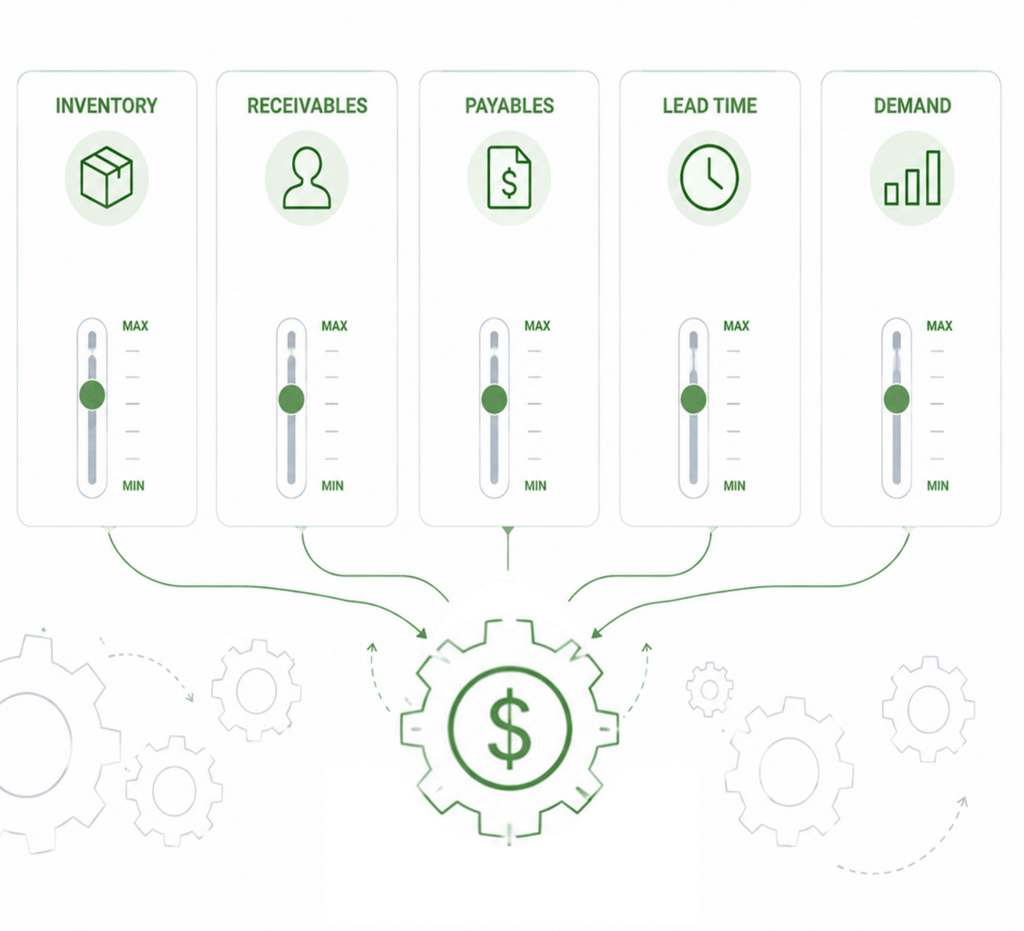
Operating Working Capital (OWC) measures how much capital is tied up in a company’s day-to-day operations. By focusing specifically on operating current assets and operating current liabilities – such as inventory, accounts receivable, and accounts payable – OWC provides a clearer view of operational cash flow, cash conversion efficiency, and business performance than broader liquidity measures.
Companies that actively manage operating working capital can improve cash generation, strengthen liquidity, reduce funding requirements, and support sustainable growth. Conversely, poorly managed OWC often signals operational inefficiencies, forecasting gaps, process friction, or weak cross-functional alignment.
This article explains what operating working capital is, how it is calculated, how it differs from traditional working capital, and why mastering OWC is essential for operational and financial performance.


Operating Working Capital (OWC) measures how much capital is tied up in the company’s operating cycle and how efficiently operational activity is converted into cash flow.
Operating current assets and operating current liabilities are balance sheet items directly related to the company’s day-to-day operations while excluding financing-related and non-operational balances.
Financial items, such as payroll taxes, unpaid taxes, and payments on debt, are therefore excluded. Cash is also excluded as it is not directly affecting operations but is rather a consequence of how well the company performs.
| Item | Description |
|---|---|
| Operating Current Assets | Resources utilized to generate revenue, essential for the continual functioning of a business. Examples of current operational assets include inventories, accounts receivable, and prepaid operating assets. |
| Operating Current Liabilities | Liabilities resulting from the day-to-day activities of the business and can be considered a free source of funding as they are non-interest bearing. Accounts payable and prepaid operating liabilities fall under this classification. |

Want to better understand the broader concepts behind current assets, current liabilities, liquidity, and how working capital is structured on the balance sheet? Read our guide to What is Working Capital for a deeper explanation of the components and business applications behind working capital management.
Operating Working Capital helps assess how much capital is tied up in a company’s day-to-day operations and how efficiently operational activity is converted into cash flow.
These operating balances may include inventory, accounts receivable, supplier prepayments, accounts payable, customer prepayments, and other operating current assets and liabilities directly connected to the company’s operating cycle.
Operating Working Capital = Operating Current Assets – Operating Current Liabilities
Or:
Operating Working Capital = Inventory + Accounts Receivable + Supplier Prepayments – Accounts Payable – Customer Prepayments

| Item | Amount (Example 1): | Amount (Example 2): |
|---|---|---|
| (+) Inventory | $6 million | $10 million |
| (+) Accounts Receivable | $5 million | $8 million |
| (+) Supplier prepayments | $1 million | $2 million |
| (-) Accounts Payable | $7 million | $5 million |
| (-) Customer prepayments | $2 million | $1 million |
| OWC | $3 million | $14 million |
Operating working capital should not be evaluated purely based on absolute values alone. The appropriate level of OWC depends on the company’s size, operating model, industry dynamics, service requirements, and cash flow characteristics.
As a result, OWC is often more meaningful when evaluated relative to sales, operating activity, or time-based efficiency metrics such as working capital days and the cash conversion cycle.
Want to go beyond the basics?
Become a Certified Working Capital Expert with our CPD accredited course Managing Working Capital
Working capital and operating working capital are closely related concepts, but they measure different aspects of a company’s financial and operational performance.
| Item | Description |
|---|---|
| Working Capital | A broad liquidity measure that evaluates whether a company has sufficient short-term assets to meet its short-term obligations. Because it includes both operational and financial balance sheet items, it does not always provide a clear picture of how efficiently capital is being utilized within day-to-day operations. |
| Operating Working Capital | Focuses specifically on the operating current assets and operating current liabilities directly connected to the company’s operating cycle. This narrower operational focus provides deeper insight into how effectively the business converts operational activity into cash flow and how efficiently capital is deployed across inventory, receivables, payables, and related operating balances. |
Operating working capital is therefore often a more useful metric for evaluating operational efficiency, cash conversion performance, and working capital improvement opportunities.

| Working Capital (WC) | Operating Working Capital (OWC) | |
|---|---|---|
| Definition | Current Assets – Current Liabilities | Operating Current Assets - Operating Current Liabilites |
| Components | All current assets: cash, short-term investments, receivables, inventory, prepayments. All current liabilities: accounts payable, accrued expenses, taxes payable, short-term financial debt | Only operating current assets: inventory, receivables, supplier prepayments. Only operating current liabilities: accounts payable, customer prepayments |
| Purpose | Measures liquidity: can the company meet short-term obligations? | Measures how efficiently capital is deployed within daily operations. |
| Exclusions | None - it’s a broad balance sheet measure and include all financial and operating current assets and liabilities | Excludes financing-related and non-operational balance sheet items such as cash, short-term debt, accrued interest, taxes payable, and payroll liabilities. |
| Key Question Answered | Can the company meet its short-term obligations? | How effectively is capital being utilized within operations? |
| Use Case | Liquidity analysis, creditworthiness, short-term risk assessment | Operational efficiency, cash conversion cycle analysis, working capital optimization |
| Management Focus | Ensuring liabilities can be paid when due | Optimizing operational cash flow without compromising service, resilience, or growth. |
While working capital remains important for assessing short-term liquidity and financial stability, operating working capital provides a more operationally relevant perspective on how efficiently the business converts activity into cash flow.
For this reason, OWC is widely used in operational performance management, cash flow optimization, and cash conversion cycle analysis.

Operating working capital optimization is not about minimizing inventory or running the business with as little capital as possible. It is about aligning operational resources with the company’s business model, service requirements, growth ambitions, and cash flow needs.
The strongest performers are not necessarily the companies with the lowest operating working capital, but those operating with the right level of OWC for their operating environment.
Both excessively high and excessively low operating working capital can create operational inefficiencies, cash flow pressure, and performance risks.
| OWC Level | Operational Impact | Typical Business Consequence |
|---|---|---|
| Too much OWC | Excess capital tied up in inventory, receivables, or inefficient processes. Weaker cash conversion and increased funding requirements. | Trapped cash, excess and obsolete inventory, slow collections, reduced flexibility, and lower returns. |
| Balanced OWC (Setpoint) | Supports operations efficiently while balancing liquidity, resilience, service levels, and growth. | Stable operational flow, healthy cash conversion, and improved financial flexibility. |
| Too little OWC | Insufficient operational buffers creating stockouts, delays, firefighting, and liquidity pressure. | Expediting costs, missed sales, strained supplier and customer relationships, and operational instability. |
The challenge is therefore not simply reducing operating working capital, but understanding the level required to support efficient and resilient operations without creating unnecessary cash absorption or operational instability.
Working Capital Hub refers to this operational equilibrium as a company’s Operating Working Capital Setpoint – the level of working capital required to support the business model, operating structure, and service expectations effectively over time.
Want to explore this concept further? Read: The Operating Working Capital Setpoint – Finding the Sweet Spot Between Cash, Growth and Resilience.
To better understand what drives different levels of operating working capital across industries and business models, explore: Working Capital Drivers – Key Drivers and Improvement Levers
A company with positive operating working capital has more operating current assets than operating current liabilities. This means capital is tied up in operations and must typically be funded through cash flow, equity, or external financing.
Conversely, a company with negative operating working capital operates with operating current liabilities exceeding operating current assets. In these situations, suppliers and customer prepayments effectively finance part of the company’s operating cycle.
Negative operating working capital can be a powerful source of low-cost funding and is common in industries with:
Examples include grocery retail, e-commerce, and certain project-based industries such as construction.
However, negative operating working capital also increases sensitivity to changes in demand and cash inflows. A sudden decline in sales or customer prepayments can quickly create funding pressure and liquidity risk.
Companies operating with negative OWC therefore require strong cash flow visibility, disciplined liquidity management, and close monitoring of short-term operating performance.

Looking at operating working capital as an absolute value alone provides limited insight into performance. Two companies may report similar levels of operating working capital while operating with completely different levels of efficiency, cash conversion performance, profitability, and operational complexity.
Operating working capital should therefore be evaluated relative to the business activity it supports, the operational structure of the company, and the perspective from which performance is being assessed.
Operating working capital should be evaluated from different perspectives depending on the company’s objectives and management focus.
| Perspective | Key Question | Common Metrics |
|---|---|---|
| Strategic | Is the company generating sufficient revenue and return from the capital tied up in operations? | OWC as % of Sales, Return on OWC |
| Operational performance | How efficiently does cash move through day-to-day operations? Which operational areas are driving working capital inefficiencies? | Cash Conversion Cycle, including inventory, AR and AP ratios (CCC, DIO, DSO & DPO) |
One of the most common ways to evaluate operating working capital performance is to measure OWC relative to revenue:
OWC % = Operating Working Capital / Last 12 months Revenue
This relative metric shows how much operating working capital is required to support a given level of revenue.

Lower OWC relative to revenue may indicate stronger cash conversion efficiency and more effective use of operational capital, while higher ratios may suggest excess inventory, slow collections, operational inefficiencies, or structurally higher working capital requirements.
Tracking the ratio over time can help identify trends in operational efficiency, cash absorption, and working capital performance. However, the “right” level always depends on the company’s business model, operating structure, service requirements, and strategic priorities.
Another common way to evaluate operating working capital performance is to measure the return generated from the capital tied up in operations:
ROWC = Operating Profit / Operating Working Capital
Return on Operating Working Capital (ROWC) measures how effectively a company generates operating profit from the capital invested in inventory, receivables, payables, and other operating balances.
Higher returns may indicate stronger operational efficiency, better cash conversion, and more effective utilization of working capital. Lower returns, on the other hand, can signal excess capital tied up in operations, operational inefficiencies, or weak profitability relative to the level of invested operating capital.
ROWC is particularly useful when evaluating capital efficiency over time or comparing operational performance across business units, product categories, or peer companies. However, results should always be interpreted in the context of the company’s operating model, margin structure, asset intensity, and growth strategy.
From an operational perspective, many companies also monitor the Cash Conversion Cycle (CCC), which measures how efficiently cash moves through inventory, receivables, and payables across the operating cycle.
CCC = DIO + DSO – DPO

The Cash Conversion Cycle is typically analyzed through three operational metrics:
Together, these metrics help companies understand how operational decisions influence cash flow, liquidity, responsiveness, and working capital efficiency.
Unlike more static balance sheet measures, the CCC provides insight into how quickly invested capital is converted back into available cash and how efficiently cash flows through day-to-day operations.
Want to explore the Cash Conversion Cycle further? Read: Working Capital and the Cash Conversion Cycle – Definition, Calculation & Considerations
Working capital ratios derived from the balance sheet and income statement provide valuable insight into liquidity, capital efficiency, and operational performance. However, these metrics also have important limitations.
By design, balance sheet KPIs provide only a periodic snapshot of performance rather than a complete view of how capital moves through day-to-day operations. As a result, aggregated ratios may sometimes hide operational imbalances, customer-specific payment issues, inventory distortions, or emerging working capital risks.
| Limitation | Example |
|---|---|
| Snapshot view | Month-end balances may not reflect activity between reporting periods |
| Aggregated averages | A healthy DSO may still hide severely overdue customers |
| Limited operational visibility | KPIs show outcomes, but not always the operational root causes |
| Slow trend detection | Monthly reporting may delay visibility into emerging issues |
Despite these limitations, balance sheet KPIs remain essential for benchmarking, external reporting, trend analysis, and communication with investors, lenders, and management teams.
To overcome these gaps, many companies complement traditional balance sheet KPIs with transaction-level operational data. This provides greater visibility into the underlying drivers behind inventory, receivables, payables, and cash flow performance, enabling more proactive and operationally relevant working capital management.

Improving Operating Working Capital is about much more than tightening budgets – it’s about making smarter use of the assets and liabilities tied to daily operations.
By managing receivables, payables, and inventory more effectively, companies can free up cash, strengthen liquidity, and support growth without relying on external financing.
Below are 10 practical strategies to help optimize OWC and boost overall business performance.
Want to learn more about inventory management? Check out Working Capital Hub’s complete guide here.
Want to learn more about receivables management? Check out Working Capital Hub’s complete guide here.
Want to learn more about payables management? Check out Working Capital Hub’s complete guide here.
By implementing the above strategies, a company will improve its working capital and strengthen its financial position, ultimately enhancing its ability to meet short-term obligations and support long-term growth.

Operating Working Capital (OWC) is far more than a financial metric – it reflects how effectively a company converts operational activity into cash flow, liquidity, and long-term business performance.
By focusing on operating balances such as inventory, receivables, and payables, OWC provides insight into how efficiently capital is deployed across day-to-day operations and whether cash is being productively utilized or unnecessarily tied up.
Companies that understand their Operating Working Capital Setpoint, monitor performance using both financial and operational metrics, and continuously optimize their operating processes can strengthen cash flow, improve resilience, and support sustainable growth.
In today’s competitive environment, mastering operating working capital is not simply about improving balance sheet efficiency – it is about building a more agile, resilient, and financially sustainable business.
Turn theory into practice and boost your career with accredited training. Become a Certified Operating Working Capital Expert by enrolling in our flagship course: Managing Working Capital.
Categories