Introduction - what is a good cash conversion cycle
The Cash Conversion Cycle (CCC) is often treated as a race – the shorter, the better. After all, freeing up cash faster sounds like a universal win.
But the truth is more nuanced: a relentlessly shrinking CCC can hurt just as much as it helps.
When companies push too hard to reduce working capital, they often weaken the very operations that generate it – starving their supply chain, suppliers, and customers of the flexibility they need.
This article explores why the CCC is one of the most misunderstood metrics in finance, what is a good cash conversion cycle, and why “faster” isn’t always “smarter.”
The goal isn’t to minimize working capital – it’s to optimize it around a level that supports the business effectively and sustainably.
The smartest companies don’t chase the shortest Cash Conversion Cycle – they design the right one to fuel performance, resilience, and sustainable cash flow.
The Misunderstood Metric - Why a Shorter Cash Conversion Cycle isn't Always Better
The CCC is widely used as a proxy for efficiency, but in reality, it measures timing, not performance.
A short CCC doesn’t necessarily mean operations are efficient – it may simply mean the company is running leaner than its business model can safely support.
A low CCC can mask:
Understocked inventory, leading to missed sales and firefighting in operations.
Overstretched payables, damaging supplier relationships and increasing supply risk.
Overtight customer credit and receivables, limiting growth or straining client partnerships.
The CCC doesn’t tell you why working capital moves – only how fast.
Without context, it can be a deceptive metric, encouraging actions that improve liquidity at the cost of resilience.
When a Longer Cycle Can Be the Smarter Choice
In most cases, a shorter Cash Conversion Cycle is desirable. Releasing cash from operations improves flexibility, reduces funding pressure, and strengthens financial efficiency.
But only up to a point.
When operating working capital is reduced without regard for how the business actually operates, the result can be false efficiency: a better-looking ratio achieved at the expense of service, supply stability, customer relationships, or future growth.
That is why not all cash tied up in operations should be viewed as waste. In some situations, allowing the cycle to run slightly longer is the smarter choice – not because more operating working capital is inherently better, but because the business may need that buffer to perform effectively and sustainably.
A slightly longer CCC can make strategic sense when it supports the operating model in ways that create more value than the cash it consumes:
Inventory as a resilience buffer – Holding additional stock may protect service levels when demand is volatile, supply lead times are unstable, or replenishment risk is high. In these cases, the carrying cost of inventory may be lower than the cost of missed sales, production disruption, or emergency action.
Customer credit as a commercial lever – More flexible payment terms can support customer retention, strengthen competitiveness, or unlock growth in markets where credit is part of the commercial proposition. The trade-off is justified when the incremental value outweighs the additional cash tied up.
Supplier payment as a relationship decision – Paying suppliers on time, or in some cases earlier, may strengthen continuity of supply, improve collaboration, or secure preferential treatment when capacity is constrained. Extending DPO is not always the most value-accretive choice.
Each of these decisions may lengthen the cycle. But if they improve reliability, protect revenue, or strengthen critical relationships, they may still improve overall business performance.
The key is not to make the cycle longer – or shorter – by default. It is to ensure that any reduction in working capital is anchored in operational reality and does not weaken the total business system in the process.
A strong Cash Conversion Cycle isn’t always the shortest one – it’s the one deliberately shaped to balance cash, resilience, growth, and operational strength.
Want a sharper view of cash and performance?
Explore the Hub’s complete guide to the Cash Conversion Cycle.
A “good” CCC isn’t the shortest possible one – it’s the one that fits the operating model, risk appetite, and working capital setpoint.
The setpoint represents the level of operating working capital a business needs to run smoothly: enough to support demand, supply stability, and service, but not so much that cash is wasted in idle buffers.
Smart working capital management starts with this mindset:
“Optimize the Cash Conversion Cycle – don’t minimize it.”
Most importantly, improving the Cash Conversion Cycle should never become a siloed exercise.
Reducing DPO pressure in one area while increasing inventory risk or customer friction elsewhere does not improve working capital – it simply shifts the burden across the business.
The goal is not to optimize one part of the cycle in isolation, but to improve the total flow of cash, goods, and decisions across functions.
How to Manage the Cash Conversion Cycle Strategically
In practice, that means:
Define operational setpoints for DIO, DSO, and DPO that reflect how the business really works.
Avoid “artificial efficiency.” Cutting inventory or credit too aggressively may improve the CCC but disrupt operations.
Review CCC trends cross-functionally, connecting finance with supply chain, sales, and procurement.
Combine ratio trends with transaction data – disputes, overdue items, slow-moving stock – to identify real causes.
Simulate scenarios to understand trade-offs: What happens to cash and service if DSO or DIO change by 10 days?
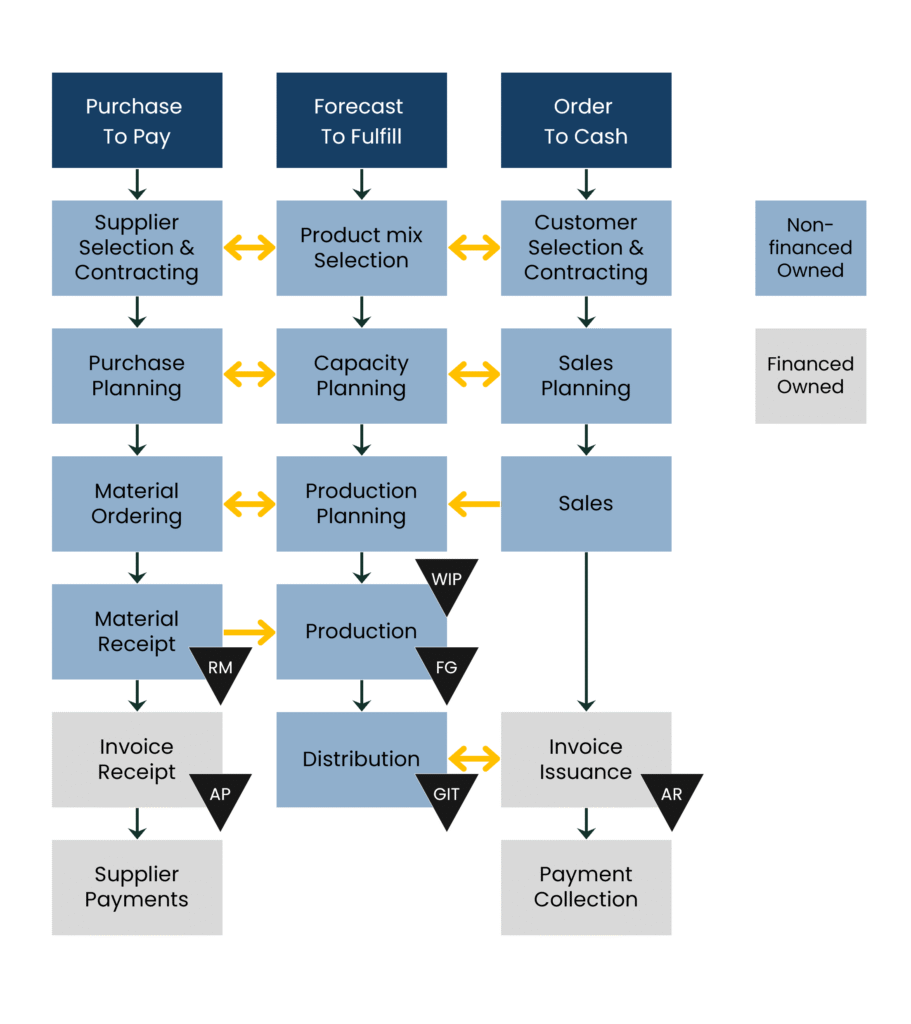
Improve the total flow, not just one metric – Align P2P, F2F, and O2C so working capital improvements strengthen the full operating model rather than shifting pressure from one function to another.
When calibrated to its setpoint, the CCC becomes a living control mechanism, balancing cash efficiency with operational performance.
The strongest Cash Conversion Cycles are designed for business performance, not simply reduced for financial optics.
Key Takeaway
The Cash Conversion Cycle is not a scoreboard – it’s a steering wheel.
Its purpose is to help companies balance liquidity and performance, not to chase the lowest number.
The winning formula to answer the question “what is a good cash conversion cycle” is simple:
Enough working capital to support the business.
No more than what’s needed to run it efficiently.
When managed around this setpoint, the CCC becomes a source of stability, agility, and competitive advantage – not just another financial ratio.
The Cash Conversion Cycle (CCC) is one of the most widely used working capital metrics - but what does it actually measure? This article explains how to calculate the cash
What is a good Cash Conversion Cycle? Most companies treat the Cash Conversion Cycle (CCC) as a race to the bottom - the shorter, the better. But in reality, a
Distorted demand signals don’t just disrupt operations - they quietly destroy working capital. Small shifts in consumer behaviour can cascade into bloated inventory, volatile capacity, and contaminated demand data across
Take the course Masterclass –Managing Working Capital at the Hub’s learning center My Academy Hub and gain the skills to turn liquidity into growth and resilience.