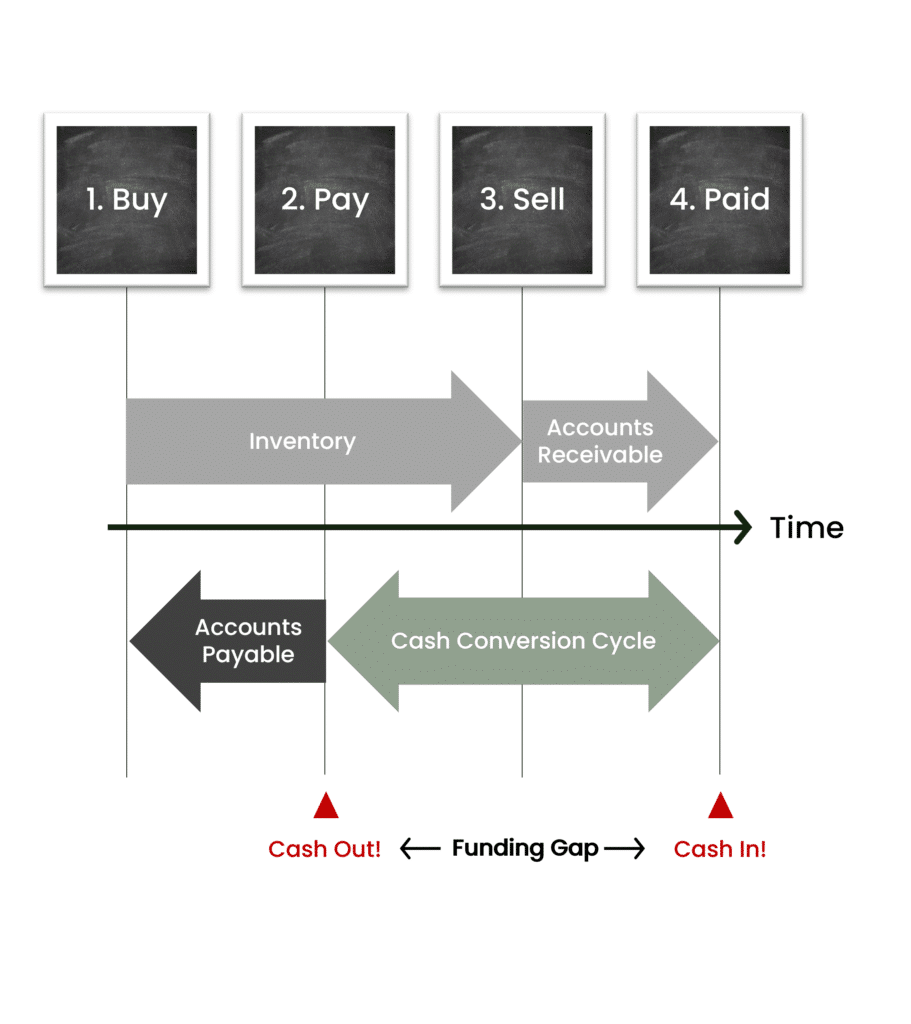
At its core, the Cash Conversion Cycle (CCC) measures how long cash is tied up in a company’s day-to-day operations.
It tracks the journey of cash as it moves through the business – from the moment a company commits cash to buying or producing goods and services, to the moment that cash is recovered through customer payments.
In simple terms, the CCC shows how efficiently a business turns its operating activity into cash.
This matters because profit and cash are not the same thing. A company can be profitable on paper but still have significant amounts of cash locked up in inventory sitting in warehouses, receivables waiting to be paid, or inefficient supplier payment flows across the supply chain.
The CCC helps make that hidden capital visible.
The metric captures three core stages of the operating cycle:
These three stages are critical because they represent the main places where operating cash becomes tied up – or released.
To measure this, the Cash Conversion Cycle brings together three underlying operating working capital metrics:
Taken together, these metrics provide a time-based view of working capital efficiency.
They show not just how much working capital is invested, but how long that cash remains trapped in the operating cycle before it returns to the business.
That is what makes the CCC so useful: it connects operational decisions in supply chain, sales, and procurement directly to liquidity, cash flow, and financial flexibility.
Let us now look at how to calculate the cash conversion cycle.
The Cash Conversion Cycle shows how efficiently a business turns operations into cash.
The Cash Conversion Cycle is calculated as:
CCC = DIO + DSO – DPO
Where:
At face value, the formula is simple:
How long cash is tied up in inventory and receivables, minus the time you are able to delay paying suppliers.
Each component represents a different stage where cash is either committed, trapped, or released.
And importantly, the formula assumes that these stages follow a clean, sequential flow. In reality, they often overlap, vary by product, and behave differently across customers and suppliers.
That is why understanding the logic behind the formula matters just as much as calculating it.
Want a sharper view of cash and performance?
Explore the Hub’s complete guide to the Cash Conversion Cycle.
Rather than thinking of CCC as a static KPI, it is more useful to see it as a timeline of cash moving through the operating cycle.
Each component reflects a different operational reality:
DIO measures the time between investing cash in inventory and converting that inventory into revenue.
This is the first point where cash becomes tied up in the process.
Once a sale is made, cash is still not in the bank. DSO measures the time between invoicing and actually receiving payment.
DPO measures how long a company takes to pay suppliers, effectively capturing how much of the operating cycle is financed externally.
When combined, these three elements answer a simple but powerful question: How many days does cash remain tied up in the operating cycle before it returns to the business?
This can also be understood as the company’s funding gap – the period during which the business must finance its own operating activity.
In practical terms, the sequence looks like this:
That is why:
CCC = DIO + DSO – DPO
Or put differently:
CCC = the net number of days cash is out of the business
Below is a simplified example for a company with the following annual figures:
| Item | Value ($'000) |
|---|---|
| Revenue | 100,000 |
| Cost of Goods Sold | 60,000 |
| Inventory | 12,000 |
| Accounts Receivable | 15,000 |
| Accounts Payable | 10,000 |
Step 1: Calculate each component
| Metric | Formula | Calculation | Result |
|---|---|---|---|
| DIO | Inventory / COGS * 365 | 12,000 / 60,000 * 365 | 73 days |
| DSO | Accounts Receivable / Revenue * 365 | 15,000 / 100,000 * 365 | 55 days |
| DPO | Accounts Payable / COGS * 365 | 10,000 / 60, 000 * 365 | 61 days |
Step 2: Calculate CCC
| Metric | Formula | Calculation | Result |
|---|---|---|---|
| CCC | DIO + DSO - DPO | 73 + 55 - 61 | 67 days |
A Cash Conversion Cycle of 67 days means that, on average, cash is tied up in the operating cycle for 67 days between paying suppliers and collecting cash from customers.
In practical terms:
So the company must effectively finance 67 days of operations with its own capital or external funding.
Is 67 days good or bad? On its own, the number doesn’t tell you much.
A CCC of 67 days could be:
This is because the Cash Conversion Cycle is not just a measure of efficiency – it reflects the underlying structure and constraints of the business.
To interpret CCC properly, you need to consider the operating context.
Example: Supply chain structure
Example: Production and operational complexity
Example: Customer dynamics
Example: Supplier relationships and bargaining power
Example: Industry norms
This is where CCC becomes more strategic.
Every business operates around a natural working capital setpoint – a level of inventory, receivables, and payables that reflects:
These factors define what is structurally required to run the business. A “good” CCC is therefore not necessarily the lowest possible number – it is the right number given the current operating model.
Trying to push CCC below that setpoint can create unintended consequences:
To explore this further, see what a good Cash Conversion Cycle looks like – and why shorter isn’t always better.
Instead of asking: “Is 67 days good?” ask: “Is 67 days consistent with how this business needs to operate – and where are the opportunities to improve without breaking the model?”
Even though the Cash Conversion Cycle is measured in days, its real impact can be translated into cash.
This is what makes the metric so useful in practice: it helps illustrate why even a seemingly small improvement can be meaningful.
Every one-day reduction in CCC releases the cash equivalent of one day of operating activity.
As a rough rule of thumb:
Cash value of 1 CCC day ≈ Annual revenue ÷ 365
In our simplified example above, that means:
100,000 ÷ 365 ≈ 274
So a one-day improvement in the Cash Conversion Cycle would release approximately $274,000 of cash.
A 10-day improvement would therefore release approximately $2,740,000.
This helps put the metric into practical terms.
Even a modest reduction in inventory days, receivables days, or an improvement in supplier payment terms can release real liquidity from the business.
That cash can then be used for:
However, not every day in the Cash Conversion Cycle should automatically be removed.
Some working capital is structurally required to support a company’s operating model, service levels and commercial position.
The most valuable CCC improvements are therefore not the fastest ones, but the ones that are sustainable, structurally sound, and aligned with the business’s working capital setpoint.
Take the course Masterclass – Managing Working Capital at the Hub’s learning center My Academy Hub and gain the skills to turn liquidity into growth and resilience.